Notes · · 3 min read
Rueda, a groovebox for playing
A friend pulled out a Teenage Engineering gadget and a HiChord, and we spent an hour making music without knowing any music. I wanted that on my phone, without buying anything. That is how Rueda was born.
Over an after-lunch coffee a friend pulled out a Teenage Engineering gadget and a HiChord, and we spent an hour making music without knowing any music. I went home with one idea stuck in my head: I wanted that on my phone, without buying anything.
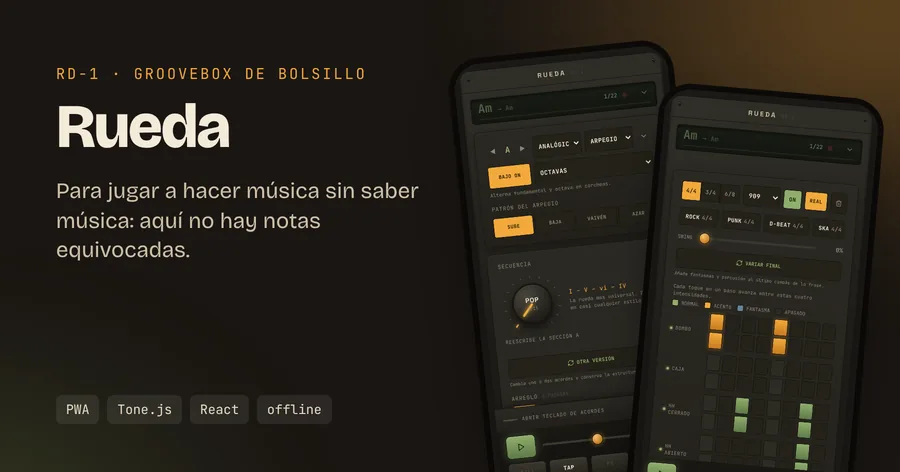
That is how Rueda was born, a pocket groovebox. On screen it calls itself RUEDA RD-1, as if it were a piece of hardware, and it handles like one: a single face, with the display at the top, the module in the middle and the transport at the bottom. Five modules: chords, melody, rhythm, looper and ideas. You pick a style, press four chords and it sounds right. There are no wrong notes here: the app only offers you the notes of the key you chose.
What it does
Fourteen style templates and thirteen sounds, with sampled guitars and drums that can be synthesised or use six real samples. An automatic bass that follows the chords. A looper that records from the microphone and calibrates the device's latency. Everything exports to WAV and MIDI, is saved on the phone itself and works offline. And there is a challenge every day, to bring you back.
Three decisions
I built it with AI, like my website. And since there was no client and no deadline, the judgement was all mine.
What not to build. Accounts, a server, ads. Everything is saved on your phone and works offline. If I stop maintaining it tomorrow, it keeps working. And your ideas can leave with you: the .rueda file is a ZIP inside, with a JSON and the looper's audio as plain files, so it opens without the app. A format only this app can read dies with it.
What to demand. 836 automated checks for a toy, and twenty of them load the app in a real browser and measure the audio. A looper that drifts "sometimes" is not fixed by listening; it is fixed by measuring: render the same song with and without a feature and compare the energy bar by bar. Measuring live gave false positives three times in a row. And three different bugs had the same shape, a number assumed to be absolute that wasn't, so the position in the song is now counted in ticks rather than seconds, which change with the tempo.
What to change. It was called "Rueda de Acordes", the chord wheel, until the wheel became one of five modules. When a name gets too small, you change it, even if it is a chore.
Two rules that are not technical
The first-time guide walks you through making a whole idea on the real app, but it does not write a single note: it says where to tap and why, never what to play. If the guide picks the chords, the first idea does not belong to whoever made it.
The daily challenge is a frame, never content. It can say "three chords, not one more"; it cannot say "use these three". And every challenge has to be checkable by the app itself: if the app cannot tell whether you met it, the streak means nothing.
What I take away
With AI, making is cheap. Deciding what not to make, and how much to demand of what you make, still costs the same.
Free, no accounts, installs from the browser: rueda.angelvalera.es. If you make something with it, send it to me.
AI multiplies. Judgement decides.